How to Have Genuine Conversations With Your Teen
Getting your teen to open up and participate in a genuine conversation can be difficult. How do you foster a genuine conversation based on truth, mutual respect, and understanding?

Nexus Family Healing
Restoring Hope. Reshaping Futures.

Categories
Filter By
search
Getting your teen to open up and participate in a genuine conversation can be difficult. How do you foster a genuine conversation based on truth, mutual respect, and understanding?
Suicide is and has been for the last decade, the second leading cause of death for adolescents in the United States. The reasons why suicide occurs are often not well understood, leaving family and friends wondering what could have been done differently. Here are some things you can do as a parent to help your child if there is a concern about suicidal thoughts or actions.
Youth at our agencies often engage in art projects as part of treatment, education, or recreation while in our care. Here are some inspiring pieces created by our talented youth.
As parents, caregivers, or guardians, the aspect of going back to school is often exciting. While this can be exciting for students, too, anxiety often rears its ugly head. There are simple things parents, caregivers, and/or guardians can do to minimize the anxiety students feel about going back to school.
Tragedies are an unfortunate inevitability of life. Grief is the aftermath. It’s the fear and sadness and impending sense of doom as we look into a future where something we loved is missing forever. While collective grief happens to large groups of people, each person’s experience or ability to cope is unique. However you feel about the tragedy, it’s important to take care of yourself and the people you care for. You are not alone in your grief.
Last summer my mom passed away. She was sick with cancer for a long time, so in theory, I had plenty of time to prepare for her passing. And yet, I will tell you now, there is no way you can ever prepare for the loss of a parent. While I grieve, I have learned that the stages of grief don’t always apply to every instance of grief or loss, and I will explain why.
It’s important to understand that someone’s gender identity and sexual identity are two different concepts. Gender identity is the personal sense of one’s own gender, while sexual identity is a person’s conception of their sexuality and who they are attracted to. You may feel uncomfortable about the way your loved one is choosing to express their gender, or maybe you don’t understand it. You may worry about the struggles they will face or worry about them being bullied or harassed by others. Here’s some tips on how you can support your loved one.
Empathy is a critical part in what makes us human: the ability to understand things from another person’s point of view helps us to better understand each other. It’s vital in creating safe spaces for our friends and loved ones to feel understood, making it an essential part of mental health care.
A common misconception of teenagers in foster care is they did something bad or wrong to end up there, but many teens end up in foster care at no fault of their own. Just like any other age group, teens in foster care want a secure, loving family.
Caring for a loved one with severe and long-standing mental health issues can be challenging and emotionally draining. If you are navigating this terrain of seeking different solutions, here are a few practical steps to help you move forward.
Recognizing when a loved one is experiencing a mental health crisis is vital in getting them the proper care they need. Whether you’re experiencing it yourself or supporting someone else, knowing what a mental health crisis is, how to recognize one, and how to respond, can be life saving for yourself and your loved ones.
As a parent, guardian, or caregiver, it’s crucial to understand the difference between discipline and abuse. Learn ways to implement effective discipline into the home that is calm, consistent, and intentional, not humiliating or hurtful.
While stress is a common topic in the workplace, it is often overlooked in discussions around caregiving. If you are looking for ways to support a caregiver in your life, here are some actions you can take to help ease their stress and be an important resource for them.
Self-Harm can be a difficult subject to talk about, but it's important parents and caretakers are educated on what it is, signs to look for, and the difference between self-harm and suicidal ideation.
Receiving a depression diagnosis for your child may not feel celebratory, but it’s an important first step toward healing. Be proud of seeking help—now focus on creating a safe, consistent, and supportive home to help your child grow and recover.
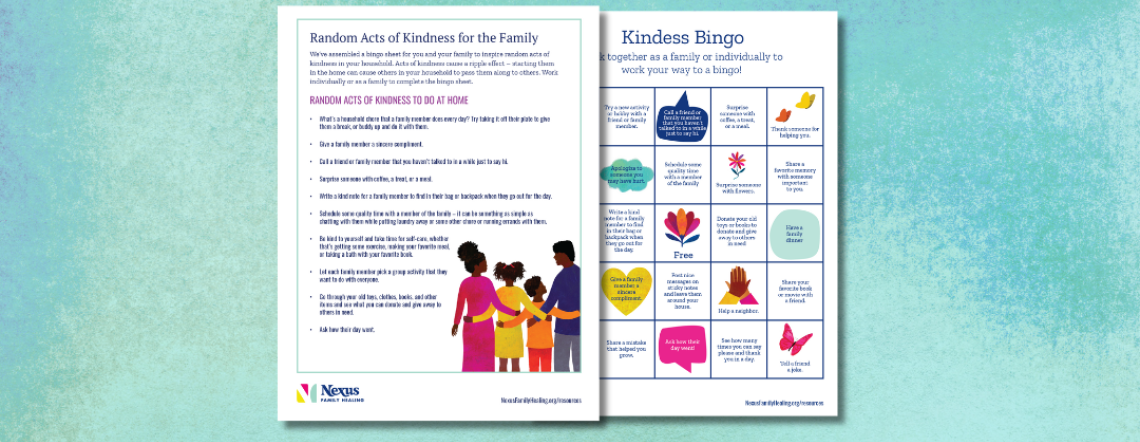
We’ve assembled a bingo sheet for you and your family to inspire random acts of kindness in your household. Acts of kindness cause a ripple effect – starting them in the home can cause others in your household to pass them along to others. Work individually or as a family to complete the bingo sheet.
Receiving a depression diagnosis for your child may not feel celebratory, but it’s an important first step toward healing. Be proud of seeking help—now focus on creating a safe, consistent, and supportive home to help your child grow and recover.
Love and kindness should go hand in hand, and random acts of kindness are scientifically proven to positively impact yourself and those around you. Making the choice to be kind and focusing on compassion can have a huge impact on mental health.
This time of year can be filled with optimism and hope, and feelings of a fresh start. It can also be a time of anxiety and uncertainty. To help yourself and your loved ones move successfully into the new year, we’re giving you tips on how to pack your theoretical suitcase filled with the good things for the new year.
Winter often means driving in snowy, icy conditions—something many Midwesterners are used to but still find stressful. For some, especially those with anxiety or past accidents, the thought of driving can bring on heightened fear or panic.
Winter is the season of stillness. We are often under a constant barrage of “new year, new me” messaging. Instead of constant change, the season invites us to slow down, embrace quiet, and enjoy time together.
How can hope improve mental health? Studies on the science of hope began in the 1980s, and it was determined that hope is an action-oriented skill that can be learned, not just something that you “feel.” To cultivate positive change, restoring hope is the vital first step.
Recently, I posed the question, “In what ways has gratitude impacted your life?” to this group. Their answers were very similar and profound, and I wanted to share their insights on how a gratitude practice can impact your life.
January for many is a cold, grey, and gloomy time of year, bringing with it the onset S.A.D (Seasonal Affective Disorder). If you are feeling down this time of year, read for some reasons why you may be feeling this way, and some solutions you can try at home.

Resources provided through our website are informational in nature and not meant to take the place of consulting your physician, mental health professional, or other qualified health providers regarding your well-being or the well-being of others.