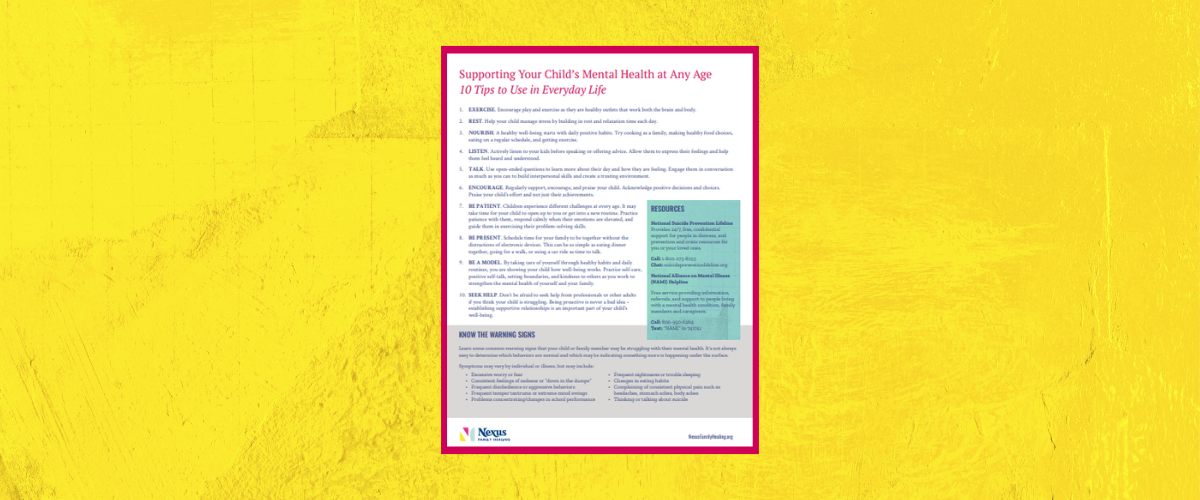


Supporting Your Child’s Mental Health at Any Age
A resource sheet explaining warning signs to watch for and 10 steps to supporting your child’s mental health.

Categories
Filter By
search

A resource sheet explaining warning signs to watch for and 10 steps to supporting your child’s mental health.

We all experience both good and bad mental health days, and when mental health is impacted, it can affect how we think, feel, and act. A mental health crisis can happen to anyone and may be triggered by stressors such as loss, trauma, or major life changes.

The journey to foster parenting is so special and worth it. I see struggling families daily through my work at a nonprofit agency. I see the generational cycle of poverty and trauma. I see how this affects children and often ask why we can’t do something about this.

Distance learning can create anxiety for both students and parents, with many caregivers feeling responsible when grades drop or stress increases. If you’re feeling overwhelmed or worried, know that you’re not alone. Here are a few quick tips to help manage those moments of stress.

We can practice being trauma-informed in daily life by approaching interactions with openness and curiosity. When we remember we don’t know what someone has been through, it can lead to more compassionate conversations and stronger relationships.

Our call to adoption started with when my mother fostered children while I was growing up. I never understand why she did it until 10 years later after I attended a foster parent training. It is not always easy, but we can no longer imagine our world any other way.

This school year has been unlike any other with all of the unexpected challenges and unknowns. It is normal for your child to feel unexpected increased anxiety about school. Here are five steps to help your child feel more confident and in control when heading back to school.

Trauma-informed care is important because trauma can impact brain development and shape emotional and cognitive functioning. To effectively support and treat individuals who have experienced trauma, providers need to understand how it influences thinking, behavior, and responses.

It can be challenging for youth and caregivers when the time comes to transition into adulthood and independence. The Child Welfare Information Gateway outlines key areas families can focus on during this transition.

Trauma-informed care is becoming increasingly common in health, education, and social services as we better understand how past experiences shape brain development and daily functioning. Its goal is to support individuals in healing from trauma through approaches that promote long-term emotional and behavioral wellbeing.

2020 brought unprecedented challenges to mental health, mindset, and overall wellbeing. As we move forward, it’s important to reflect on the highs and lows, including how we coped with struggles. The Four Steps to Letting Go can help support a healthier mindset moving into a new year.

When a loved one is dealing with depression, it's important to understand what they may be going through and what actions you can take to show your care and support. Understanding their feelings of depression may start with you asking a few questions and taking note of changes in their behavior.

Even the smallest gifts like waving to your neighbor, or paying for the person's food behind you can make a tremendous impact. It is true that in the act of being charitable, one always receives far more than one gives. Pass it on!

Today's world comes with its fair share of challenges which can make it difficult to connect with one another. Active listening, processing out loud, and accepting things we cannot change are techniques we can use to help us communicate in respectful and productive ways.

In Minnesota there are 733 children waiting for families. Foster families play a critical role as many children in foster care have experienced trauma during their critical developmental years.

We are quick to judge parents, even when we don’t know the backstory. In residential treatment, we work hard to recognize the parent’s effort in trying to find help for their child, no matter how they show up throughout the treatment process.

It is very important for the caregiver to be involved in their child's therapy. As the caregiver you provide the most treatment, your therapist needs your input, and the therapists are here to support you.

The Cornerstone Café serves as a vocational program of Nexus-Onarga Family Healing where youth in residence build real-world skills by applying, interviewing, training and working at the café.

Fostering or adopting a child can be one of the most rewarding experiences as you help a child rewrite the story of their future. We sat down with Melissa Moore, a foster and adoptive parent, to ask her what rewriting the story means to her and her family.

It can be easy to mislabel foster youth, but it’s important to recognize the trauma and loss they often carry—and their resilience in navigating it. Foster parenting goes far beyond providing basic needs; it’s about supporting emotional growth, validating experiences, and helping children feel seen, valued, and worthy.

We know more about childhood trauma and its effect on the developing child than we ever have before. The resiliency of the developing brain provides an opportunity for us to intervene and provide healthy, safe, and nurturing experiences that grow the brain and help heal.

One in four children experiences a traumatic event before age 16. Trauma differs from everyday stress in that it involves a real or perceived threat, an overwhelming sense of fear or helplessness, and a strong physical stress response such as rapid heart rate, shaking, or increased breathing.

With celebrations, graduation parties, and college preparations underway, many young adults are eager to leave home and step into new independence. In doing so, they may not always recognize the support systems that have helped them along the way. For youth in foster care, this transition can look very different.

The idea of becoming a foster parent can bring both excitement and uncertainty. In a podcast episode, a foster parent and social worker share their experiences to help ease concerns and offer insight into building families through foster care.

Resources provided through our website are informational in nature and not meant to take the place of consulting your physician, mental health professional, or other qualified health providers regarding your well-being or the well-being of others.